Italian Prog Album Art Cover Has People With Clocks for Faces
Truly iconic album covers don't just define an album, they ascertain an era, a generation, and, in some cases, an entire musical genre. Sometimes they do all three: what is The Beatles' Sgt Pepper's Lone Hearts Club album embrace, if not the ultimate manifestation of 60s psychedelia for the "peace and love" oversupply?
Sometimes anthology covers are helped on their way to iconic condition because of the musicians they feature: photogenic stars, such as Elvis Presley, David Bowie, or Prince, whose godlike images are burned into our retinas. Other iconic album covers are envisioned by creative masterminds. The firm Hipgnosis defined the 70s with their many optical illusions. Peter Saville made Factory Records a sensation with the radio waves of Joy Division'due south Unknown Pleasures (and many more than). Andy Warhol, meanwhile, dreamed upward The Rolling Stones' iconic blueish jeans crotch and zipper on Sticky Fingers. The best anthology covers come across these graphic designs bypass linear thinking and emerge with an image that is a bona fide work of art in its own right.
While art might be a matter of taste, lasting legacy is something that's more easily measured. Our listing of the 25 about iconic album covers of all time may not be exhaustive, simply it certainly reveals why album covers deserve to exist held in as loftier a regard equally more traditional modes of artwork.
While you're reading, listen to our Greatest Album Covers playlist hither.
Elvis Presley: Elvis Presley (1956)
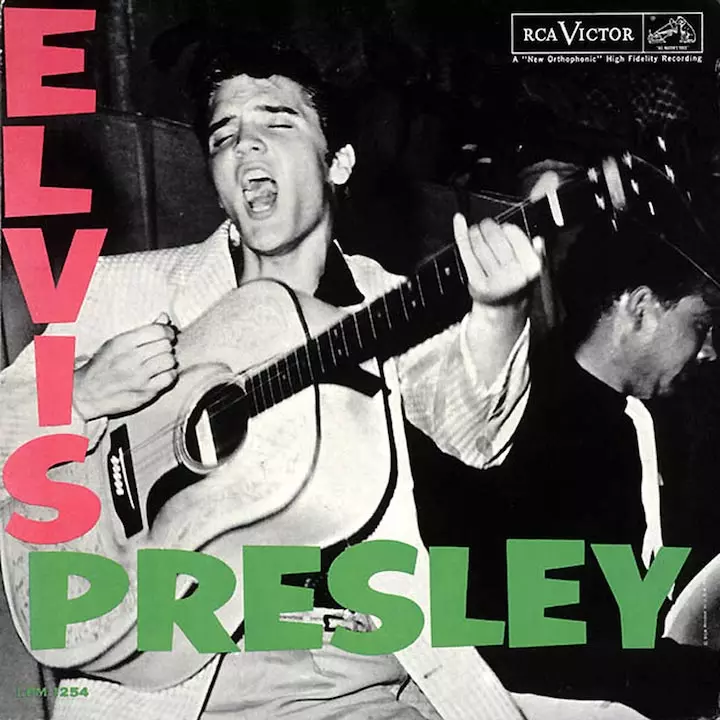
Ii simple words: "Elvis" and "Presley" (the latter barely hiding that controversial pelvis from view): that's all information technology needed to say. Caught playing the guitar and singing during a performance at the Fort Homer Hesterly Armory, Tampa, Florida, on July 31, 1955, y'all can still experience the cardinal rock'n'roll energy from a young human being prepare to take over the globe. Two decades afterward, The Clash and photographer Pennie Smith felt there was still none more rock'n'roll, and nicked the thought for the epochal London Calling vinyl album cover.
The Beatles: Sgt Pepper's Lonely Hearts Guild Band (1967)
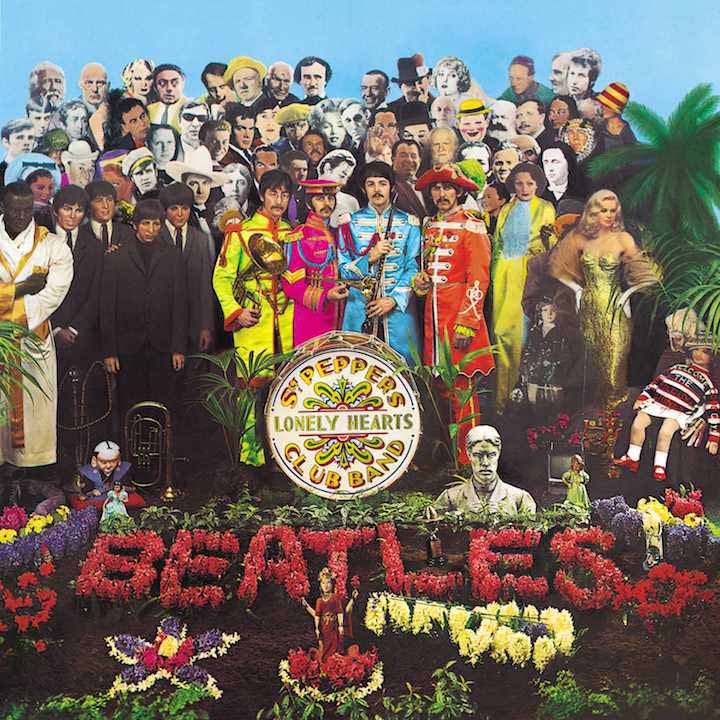
The Beatles, of course, had plenty of iconic album covers in their career, including Abbey Road and The White Album. Simply the most important and, at the time the near expensive album cover ever made, the Sgt. Pepper anthology cover remains a pop art masterpiece that has influenced everyone from Frank Zappa (We're Only In Information technology For The Money) to The Simpsons (The Yellow Album). Staged by British artist Peter Blake and his then-wife, Jann Haworth, the Sgt Pepper album cover depicted 58 different people, chosen past John Lennon, Paul McCartney, George Harrison, Peter Blake, Jann Haworth and London fine art dealer Robert Fraser, presenting a fascinating cantankerous-section of cultures, importance, and each Beatle'due south individual interests like Marlon Brando, Karl Marx, and Marilyn Monroe.
Click here for an interactive Sgt Pepper cover to discover who'due south who on one of the well-nigh important anthology covers of all time.
The Velvet Underground & Nico: The Velvet Underground & Nico (1967)
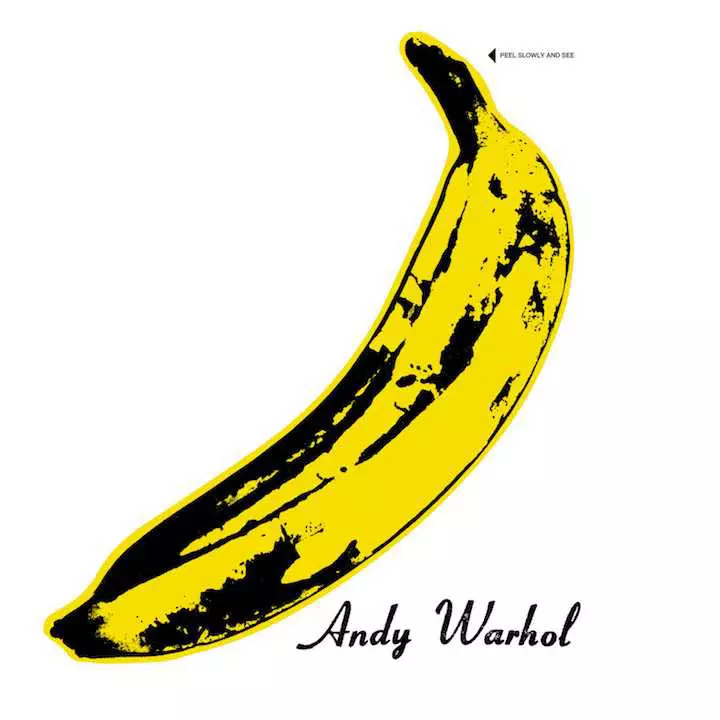
If Peter Blake's Sgt Pepper album cover is the most famous example of British pop art, then Andy Warhol's design for The Velvet Hush-hush's debut, released that same year, remains one of the almost famous from the US. It's "Peel Slowly And See" banana peel was actually a sticker that revealed the phallic fruit beneath – a typically wry move from Warhol, though the joke was on anyone who removed the sticker. Fully intact copies of the VU'due south debut album are at present hugely collectible rarities.
Frank Zappa/The Mothers Of Invention: Weasels Ripped My Flesh (1970)
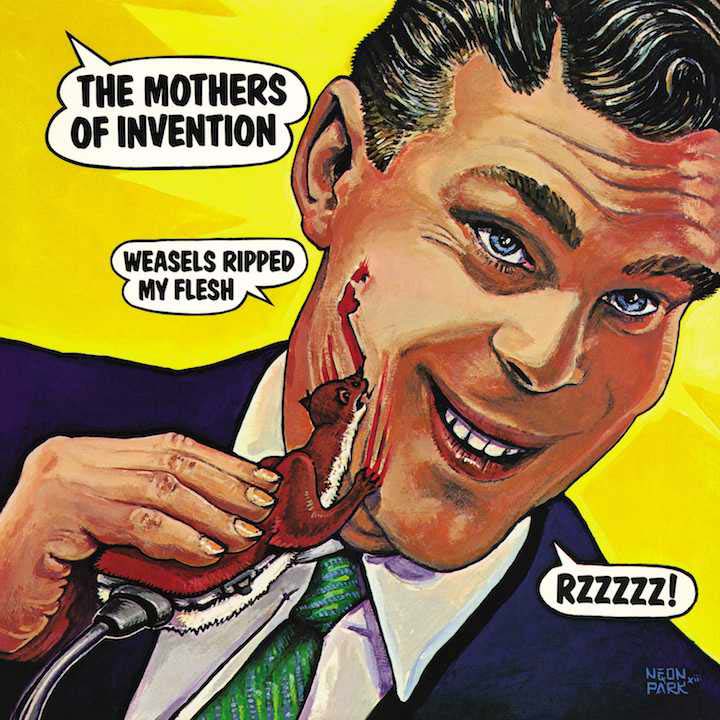
As well as creating artwork for almost every Little Feat album, illustrator Neon Park's distinctive style was put to unforgettable effect on a collection of Mothers material recorded from 1967-69. Having come up across the September 1956 edition of Man's Life, an adventure magazine whose cover pictured a man being attacked by weasels, Zappa took the "Weasels Ripped My Flesh" caption for a championship and challenged Parks to brand something "worse than this". The result: a gruesome spoof advert for an electric razor.
Roxy Music: Roxy Music (1972)
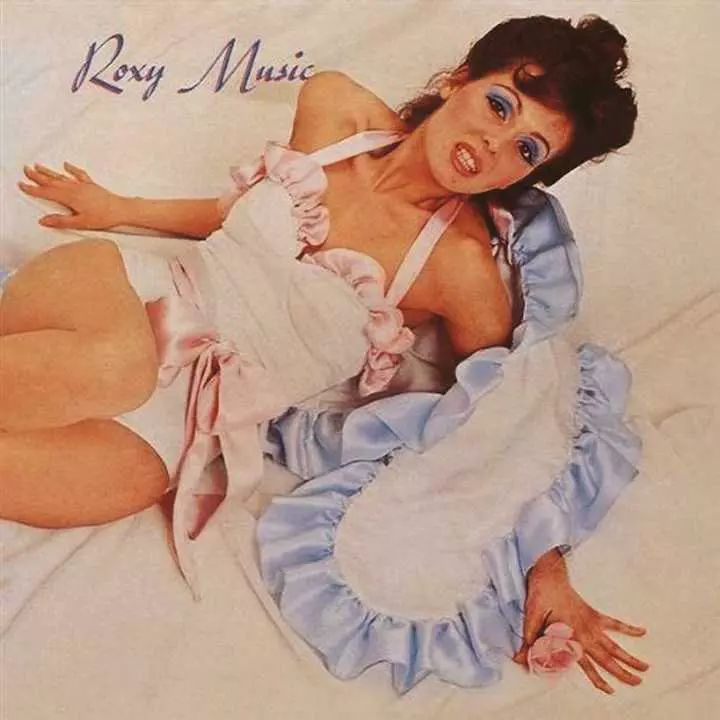
While many of the nearly memorable album covers of the early on 70s were high-concept artworks designed by the likes of Hipgnosis or Roger Dean, Roxy Music'southward arroyo was startlingly elementary: glamorous imagery, more than like a 50s mode shoot than an album cover. Often romantically linked with frontman Bryan Ferry, each model had their intriguing own back story. Having appeared as a Bail daughter in On Her Majesty'southward Secret Service, Kari-Ann Muller featured on the forepart of Roxy Music for the sum of but £20. Latterly a yoga teacher, she went on to marry Chris Jagger, whose brother has an interesting tale of his own…
Pink Floyd: The Nighttime Side Of The Moon (1973)
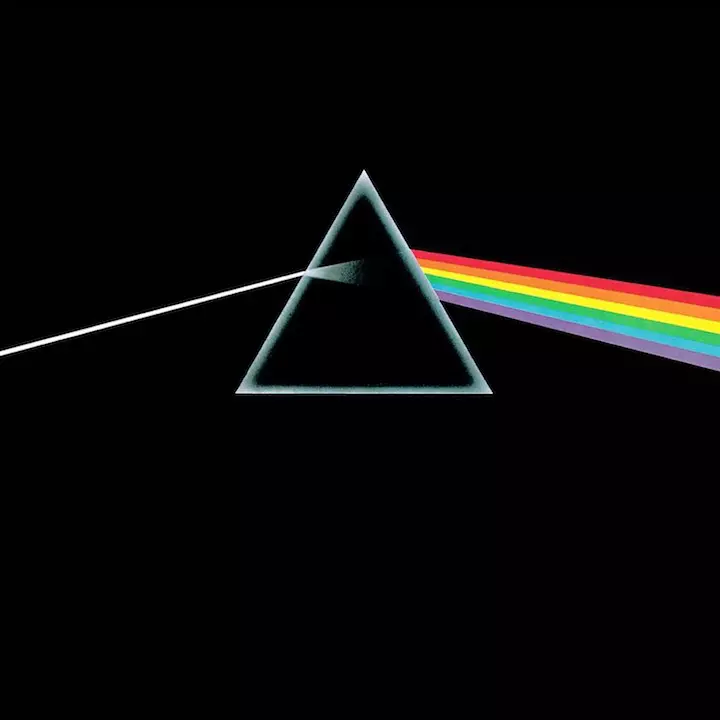
1 of the nearly iconic album covers of all fourth dimension, created by one of the nearly iconic design teams of all fourth dimension. Hipgnosis' main men, Storm Thorgerson and Aubrey Powell, came up with the concept for The Night Side Of The Moon , while their colleague George Hardie executed it: a prism refracting light into six of the 7 the colours of the spectrum (indigo is missing). The triumvirate of light axle, prism and spectrum apparently stood for iii aspects of the band and their music: aggressive stage lighting, Dark Side's lyrics and keyboardist Richard Wright'southward request that Hipgnosis create something bold however uncomplicated. Chore done, then.
David Bowie: Aladdin Sane (1973)
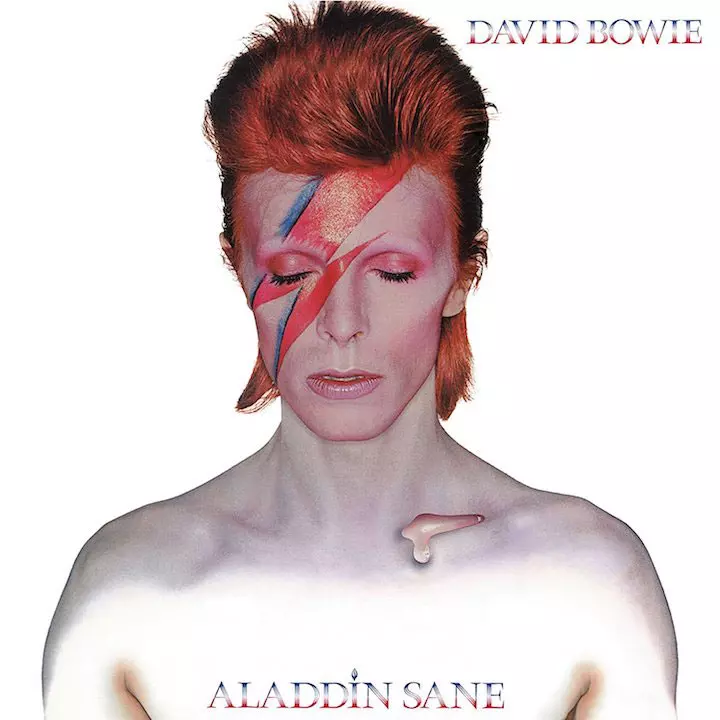
Brian Duffy's portrait remains the paradigm nearly associated with David Bowie: his Aladdin Sane persona an extension of Ziggy Stardust; the lightning bolt a representation of the "croaky thespian" that Bowie felt he had become during his sudden rise to superstardom. Yet while Bowie exuded otherworldly powers at this indicate in his career, the cover photo was taken in the very earthly confines of Brian Duffy's studio in Primrose Hill, London. The teardrop on Bowie's clavicle was an add-on of Duffy's later on the shoot: a perfect touch that makes Bowie seem both mysterious and tender at the same time.
Led Zeppelin: Houses Of The Holy (1973)
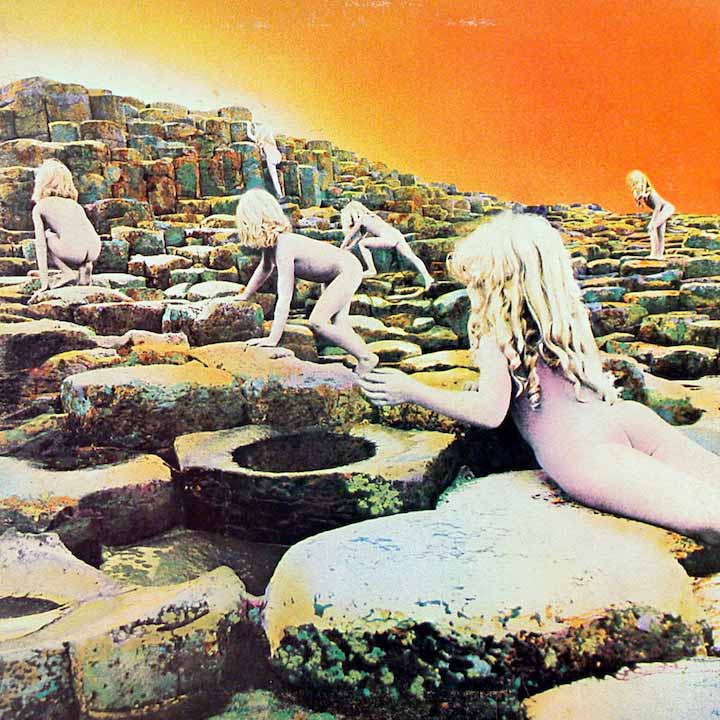
Another one of Hipgnosis' arresting album covers, the artwork for Houses Of The Holy was inspired by the ending of Childhood's Finish, a 30s sci-fi novel by writer Arthur C Clarke. A collage pieced together from several photos of two children scaling Giant's Causeway in Northern Republic of ireland, taken over a 10-day period, the artwork's eerie colouring was an accidental effect that gave the paradigm a suitably otherworldly feel. Another unintended after-event: some stores found the naked children too controversial and refused to stock the tape.
Fleetwood Mac: Rumours (1977)
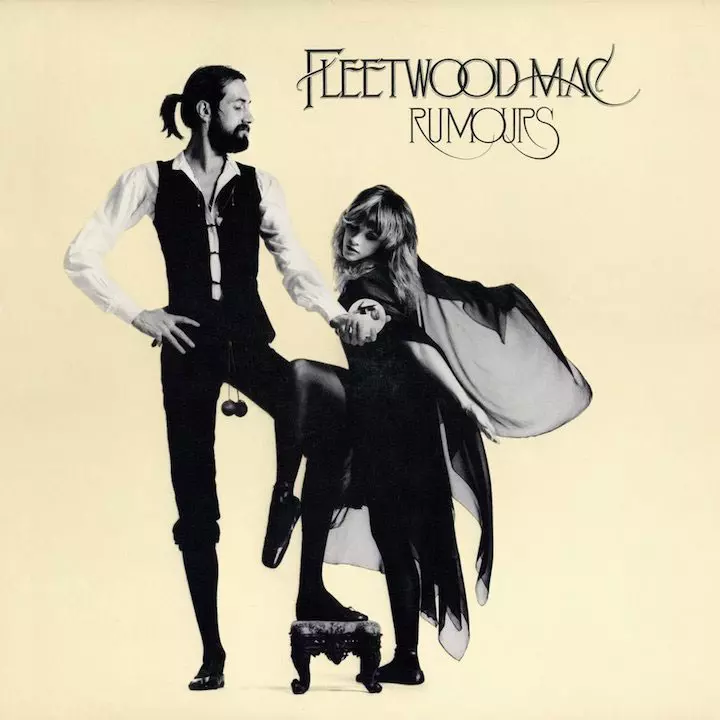
At a glance, the artwork for Fleetwood Mac's acknowledged album is unproblematic: drummer Mick Fleetwood working upward some theatrics with the none-more-melodramatic Stevie Nicks channelling the Rhiannon muse that consumed her for a period in the mid-70s. Oh, and then you lot see the nod to his manhood dangling proudly between his legs. Non just a schoolboy prank in the spur of the moment, the balls were really toilet bondage that Mick pulled from a cistern and placed between his legs before performing 1 of the ring'south earliest gigs – and at that place they would remain for futurity live performances, presumably dangling dangerously close to the drummer's tom-toms.
Prince: Purple Rain (1984)
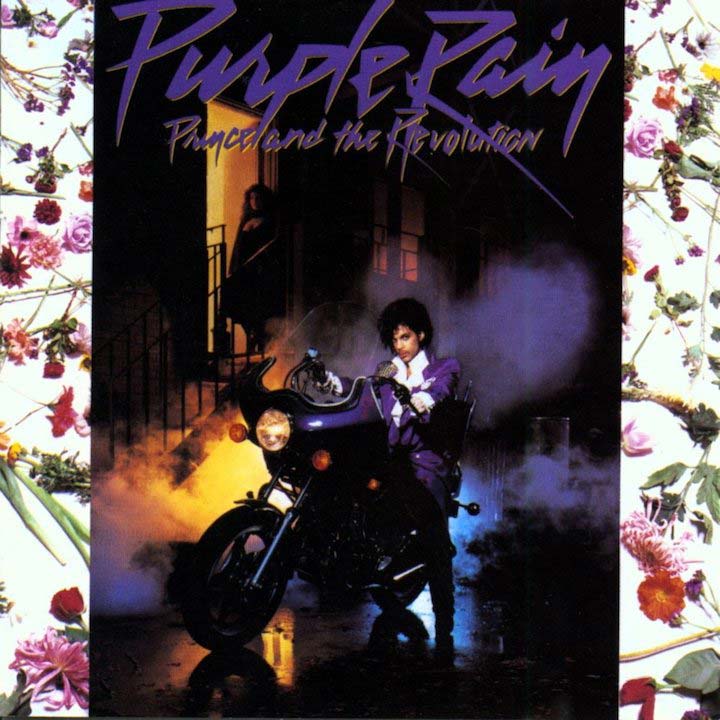
An unavoidable epitome (and album) from the mid-80s through the balance of the decade, Purple Rain introduced the world to Prince equally an enigmatic presence ready to disappear at will into the night, all Little Richard pompadour and wry smile, as if in on a joke that no i else could ever promise to understand. Photographer Ed Thrasher had previously snapped the similarly flamboyant Jimi Hendrix on a motorcycle (a shot that graced the posthumous compilation album South Saturn Delta), while, if you look closely at the wheel, you'll see the androgyny symbol that would later notice echoes in the "Dearest Symbol" that Prince changed his proper noun to.
Bruce Springsteen: Built-in In The The states (1984)
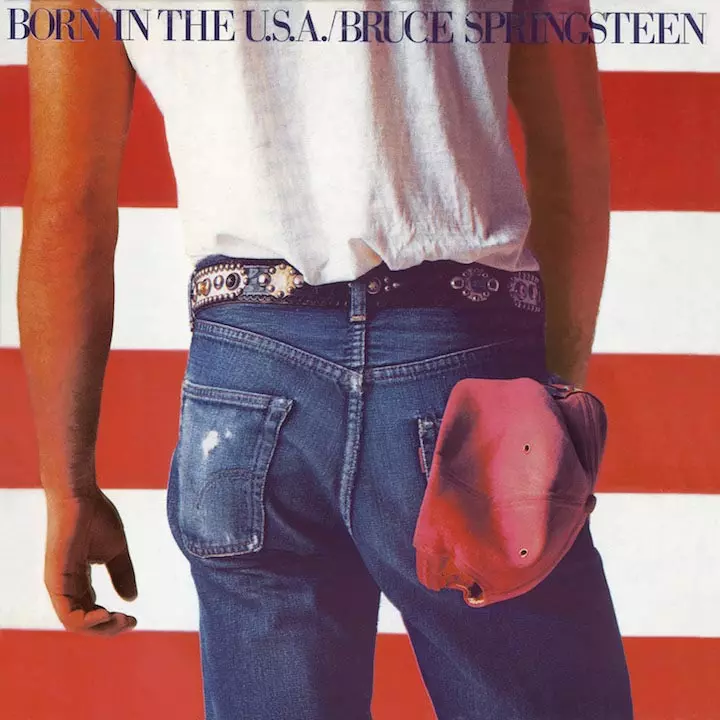
Inspired past Built-in In The U.s.a.'southward championship track, Rolling Rock photographer Annie Leibovitz shot Springsteen in red, white and blue, before a backdrop of the American flag, creating the ultimate American lowest photo for the ultimate American everyman album. However, like the album's title rail – which has been open to political misinterpretation over the years – the artwork drew some negative connotations. Some thought The Boss was relieving himself on the flag – an unintentional event of Springsteen choosing, from a number of photos, "the picture show of my ass" because it "looked ameliorate than the picture show of my face".
Grace Jones: Island Life (1985)
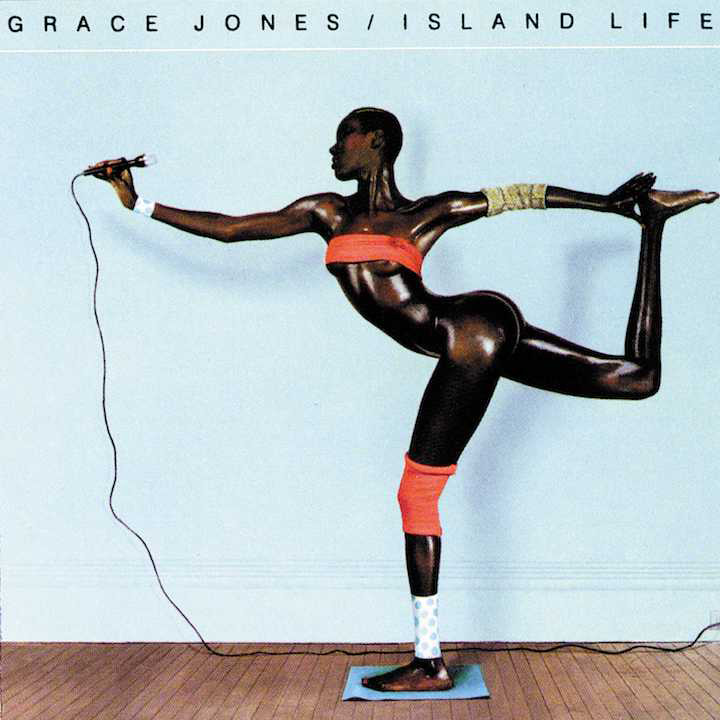
As a model, actress, and songwriter, Grace Jones' career is littered with iconic photo shoots, from downtown disco snaps to uptown magazine spreads and, of grade, a great album cover or two. While most all of her record sleeves qualify for "iconic" status, the 1985 drove Island Life remains arguably her most famous. Originally printed in a 1978 edition of New York Mag, the image was created by Jones' then partner, designer and photographer Jean-Paul Goode, who fashioned Jones' implausible posture from a composite of several photographs.
The Smiths: Meat Is Murder (1985)
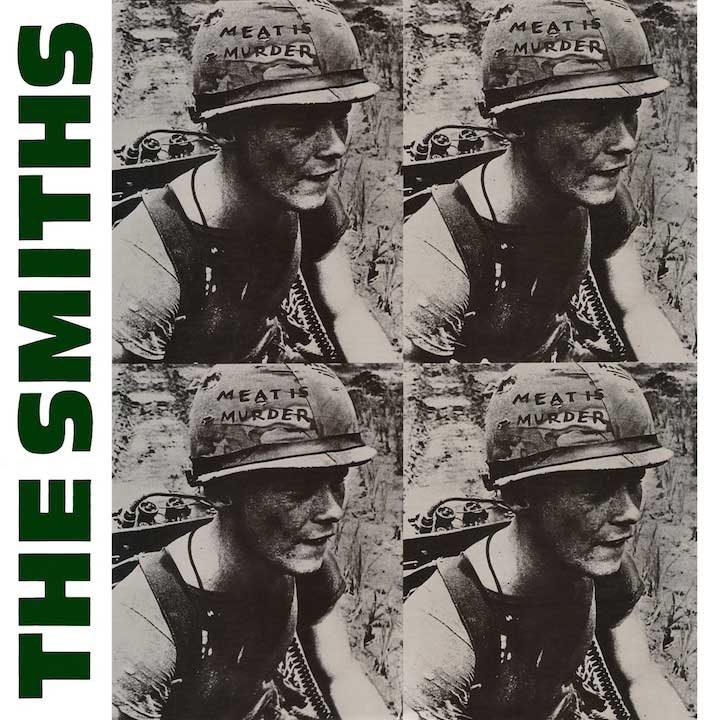
The Smiths were always handy with an center-communicable image – taken together, their anthology covers amount to a gallery of black-and-white images with histories as compelling equally Morrissey'southward lyrics. For Meat Is Murder, the devoutly vegan Morrissey sought to depict a parallel between meat-eating and warfare, picking a controversial image of a Vietnam War soldier whose helmet had been emblazoned with the album'southward title. Not that the original photo diameter the "meat is murder" slogan. The 20-year-old Marine Corporal Michael Wynn, pictured on the album embrace, had been photographed on 21 September 1967 in Da Nang, Due south Vietnam, during Operation Ballistic Charge – and the slogan he'd actually written on his ain helmet turned a countercultural catchphrase on its head with the hippie-baiting "brand state of war not love".
NWA: Direct Outta Compton (1988)
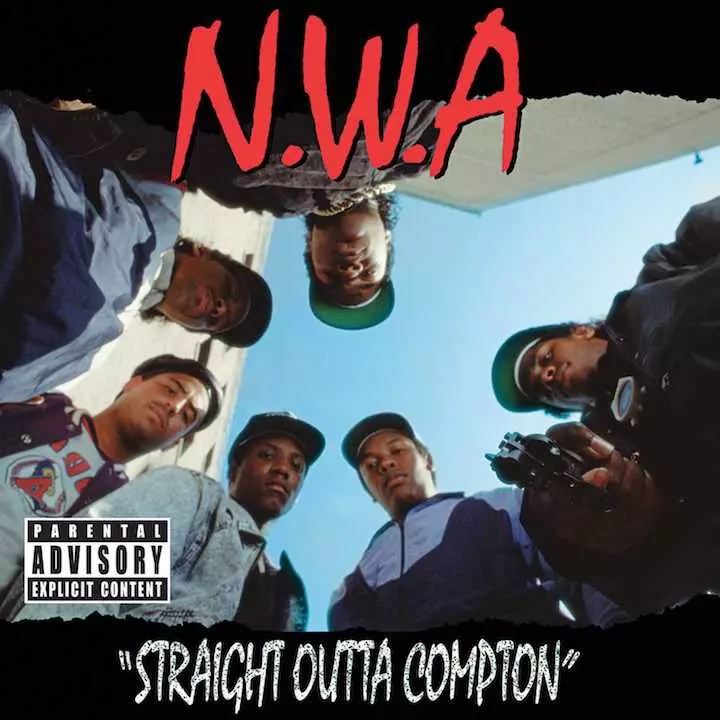
From sound to lyrical content and imagery, Straight Outta Compton defined the emerging gangsta rap genre, and its artwork has gone down in history. Speaking to CNN years after, lensman Eric Poppleton, and then just out of university, put the image's touch down to the fact that, "You lot're taking the perspective of someone who is about to be killed… Nosotros don't even impress that stuff in newspapers." Poppleton still doesn't know if Eazy-E's gun was loaded – though information technology was certainly real ("There wasn't anything fake back then," he told NME), brandished by Eazy while Poppleton and the group – with 1-time 6th fellow member, producer Arabian Prince, in tow – ducked downward an alleyway to capture the shot on the wing.
Nirvana: Nevermind (1991)
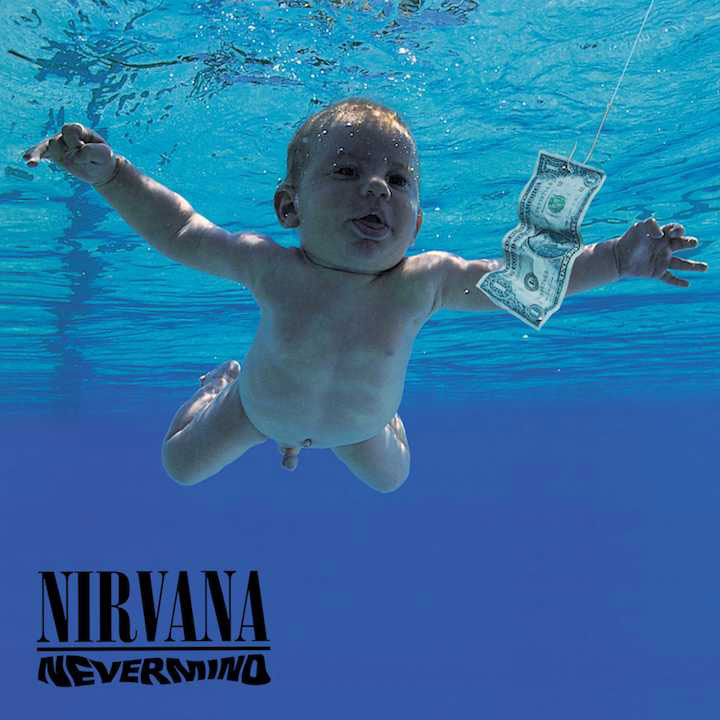
The controversial comprehend of Nevermind was interpreted by many as an innocent band reaching for the omnipotent dollar when in reality (according to Geffen Records art director Robert Fisher) it was the result of Kurt Cobain'due south fascination with a documentary on water births. Conspicuously his interest in maternal themes would crop up once again for the band's follow-up, In Utereo. While the label pushed for a cover sans baby anatomy, Cobain's proposed compromise was a sticker roofing that would read, "If you're offended by this, yous must be a cupboard pedophile." The cover design has inspired endless satires.
A Tribe Called Quest: The Low Stop Theory (1991)
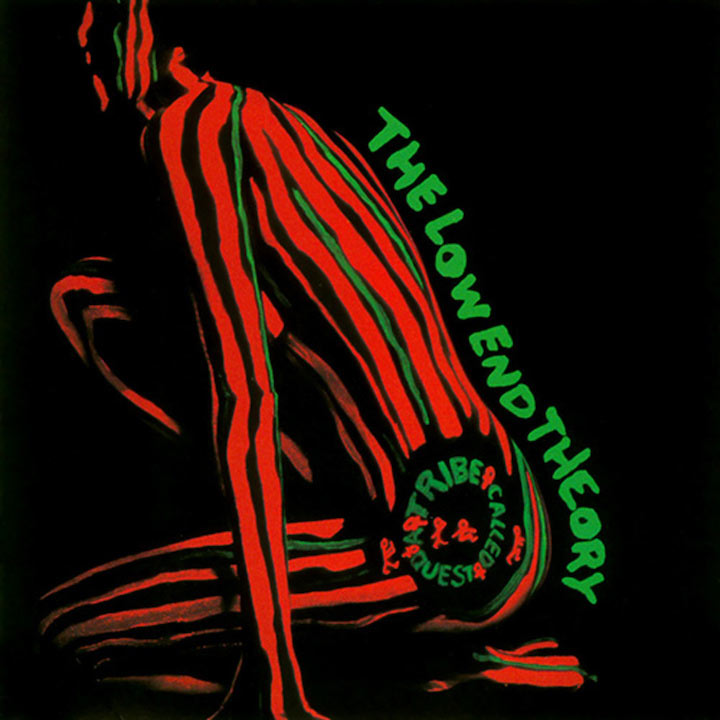
While rock music is littered with logos, the Queens rap collective A Tribe Called Quest inadvertently created one of the well-nigh recognizable symbols in hip-hop with the cover of their jazz-rap fusion masterpiece, The Low End Theory. Inspired by the provocative covers of former Ohio Players albums, it featured a nude model bedecked in DayGlo body paint that is at in one case alluring and Afrocentric at the same time. The bold colors and funky imagery lent itself to Tribe's artistic vision on what would become their breakout album. The painted lady would later appear on subsequent Tribe releases and surely inspired the equally provocative Stankonia album fine art.
Light-green 24-hour interval: Dookie (1994)
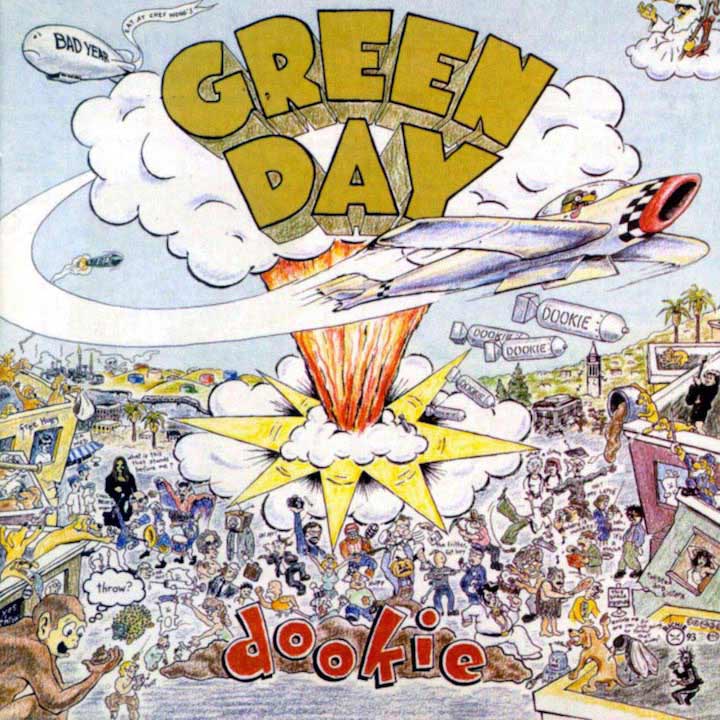
Illustrated album covers had been around for decades past 1994, but when it came to conjuring upward embrace art for Green Twenty-four hour period'due south major characterization debut, artist Richie Bucher created a comic book style world that reflected the Bay Area punk scene the ring was birthed from. Part Mad Magazine-style fold-in and Where's Waldo? for the 90s alternative scene, you don't need a magic decoder ring to spot the various Easter Eggs subconscious under the spray of dookie: from Ac/DC'due south Angus Young to Big Star'due south Alex Chilton, Patti Smith, the Academy Of California Marching Band and elements of Ramones' Rocket To Russian federation cover art, it's a real Who'due south Who of Oakland's Telegraph Avenue.
Weezer: Weezer (aka "Bluish Album") (1994)
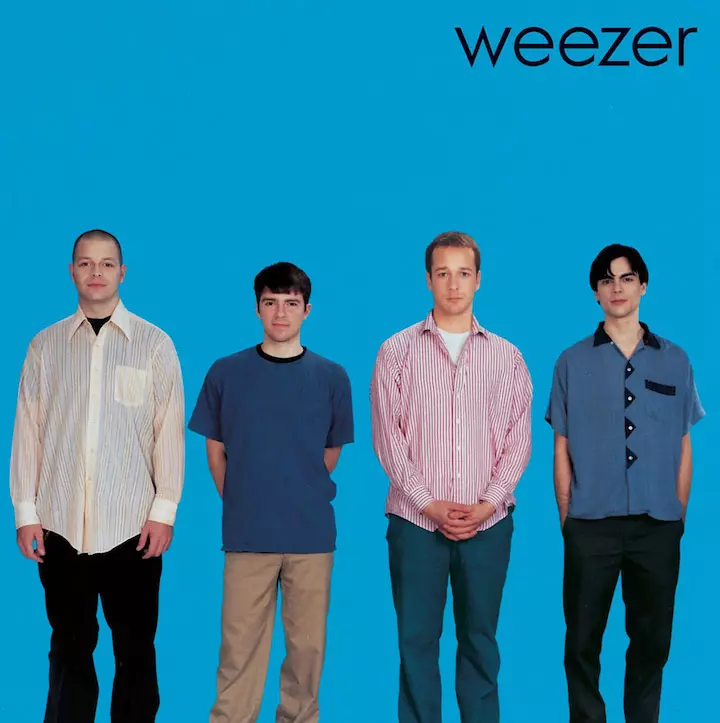
Either Weezer has a slavish devotion to monochromatic colour schemes or Rivers Cuomo has synaesthesia; either fashion, since releasing their iconic "Blue Album" in 1994, their discography represents a rainbow of releases that includes their "Greenish" (2001), "Red" (2008), and "White" albums (2016). While many early 90s releases experimented with artistic imagery, Weezer'south aesthetic was decidedly more "60s Sears family photograph", according to former Geffen A&R man Todd Sullivan. Subsequently the album's release, many pointed out its similarity to The Feelies' comprehend for Crazy Rhythms, when in reality, Cuomo was aiming for the articulate-cut boy band image of The Embankment Boys. As a upshot, Weezer non only had an iconic cover on their hands, only predicted the normcore movement.
The Smashing Pumpkins: Mellon Collie And The Infinite Sadness (1995)
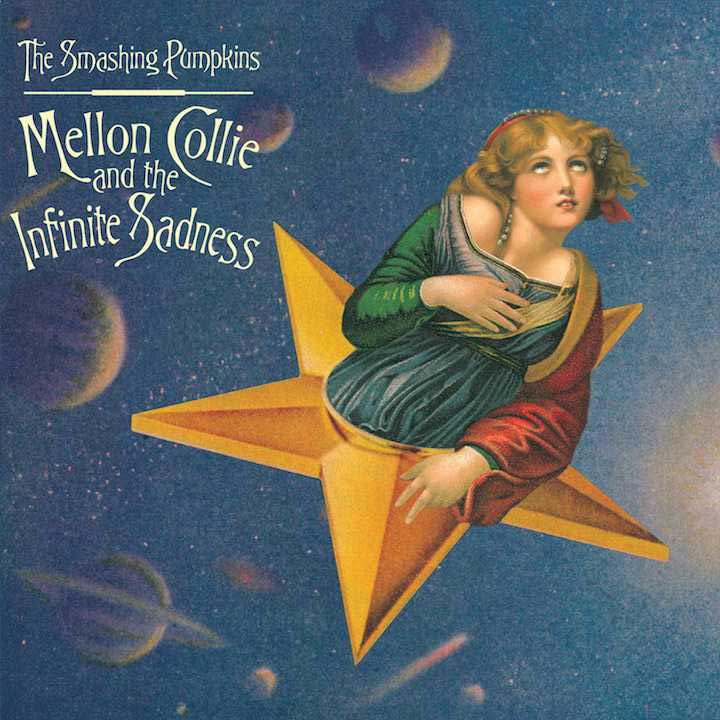
Immediately recognizable, the dreamy, Victorian-esque encompass of The Nifty Pumpkins' landmark 1995 album captures a woman in perpetual eye-roll, or a look of ecstasy that she's held onto for over 20 years. It perfectly summarises the aimlessness youth to which Corgan was preaching, and the fanciful imagery matches the grand ambitions of the sprawling, 28-track anthology. From only a series of crude, faxed sketches, illustrator John Craig (former designer for Mercury Records and the man backside some of Rod Stewart's virtually iconic sleeves) created a composite image using a celestial background from an erstwhile children's encyclopaedia, forth with the body from a Raphael painting of Saint Catherine Of Alexandria, and the woman'due south face from an 18th-century painting by Jean-Baptiste Greuze entitled The Gift (Fidelity). Though you don't demand an Art History degree to capeesh this enduring prototype.
Beck: Odelay (1996)

Some album covers are meant to convey deeper musical themes and their imagery is meticulously conceived, while others are but happy accidents. In Beck's case, the somewhat inscrutable cover image of Odelay came near later he was shown an image of a rare, Hungarian breed of herding domestic dog called a Komondor. Subsequently he couldn't stop laughing at the image that he described as a "bundle of flying Udon noodles attempting to bound over a hurdle", and with the deadline for the anthology just a day abroad, he decided it would make the perfect comprehend and left it open for estimation. Is it a bale of hay or a flying mop? The artwork has go the ultimate Rorschach test.
The Roots: Things Autumn Apart (1999)
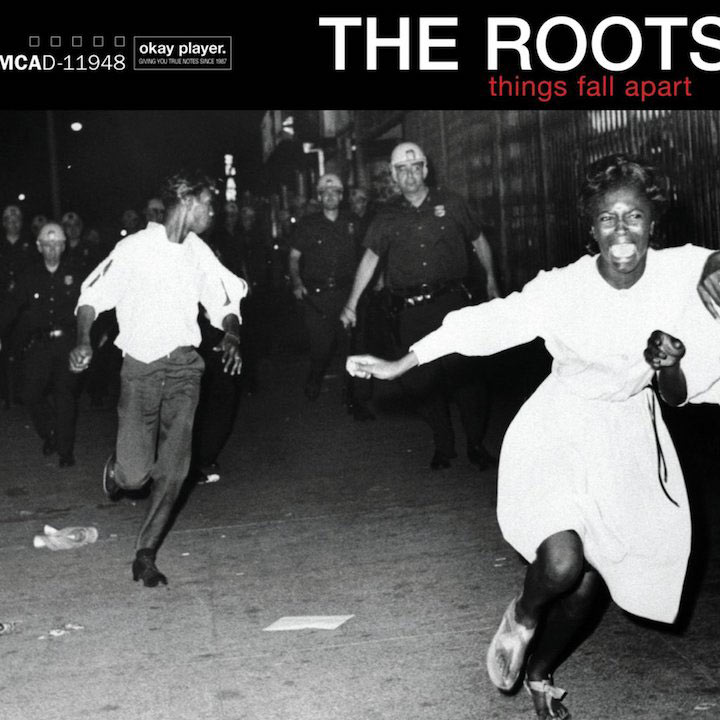
At the dawn of the Millennium, the bulk of hip-hop anthology covers were not the optimal vehicle for social commentary. At the time, The Roots were withal something of an underground human action, simply that was all about to change with their seminal album and provocative cover – or covers –for their breakthrough album. The Philly outfit released five express edition album artworks featuring famous photos that depicted "visual failure in social club", from a murdered mafia boss to a burning church building, a baby crying amid the rubble in Shanghai afterward WWII to the 90s dearth in Somalia, and, most famously, two women beingness chased by police during the 60s riots in the Bed-Stuy neighborhood in Brooklyn. While near of The Roots' previous covers just depicted the band, Things Fall Apart was a step towards social activism both in their music and imagery.
Blink-182: Enema Of The State (1999)
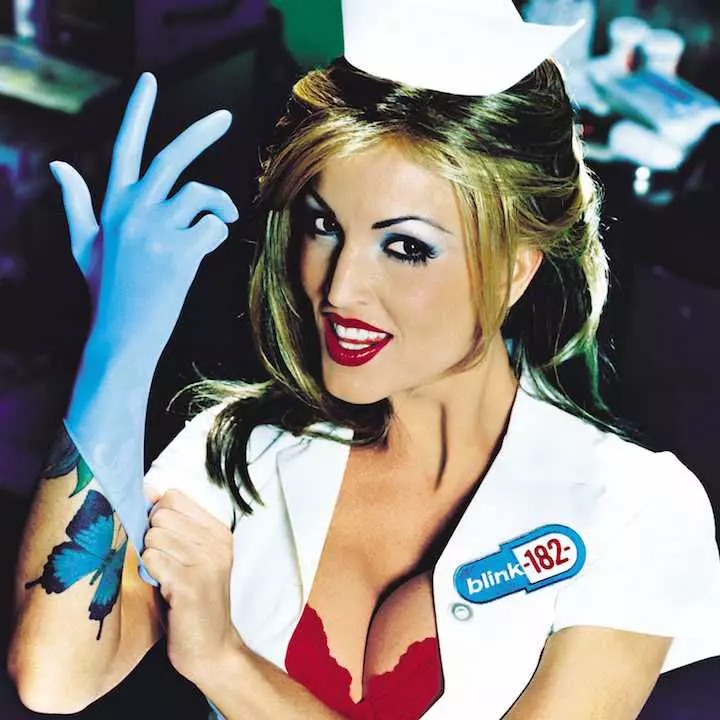
As the confront of the popular-punk explosion, Blink-182 knew their audience well and catered to it accordingly with their explicit cover to their 1999 hit album Enema Of The Land – much to the delight of their prepubescent male person fans. Adult actress and exotic dancer Janine Lindemulder posed equally a nurse for the cover, much to the chagrin of the American Cherry Cross, who demanded the ring remove their logo from the artwork, every bit it was a "violation of the Geneva Convention". Lindemulder would reprise her nurse role in the band'south video for 'What's My Age Again', thanks to music turned porn publicist Brian Gross. The comprehend and accompanying video fabricated Blink-182 famous and brought the adult manufacture to middle America.
The Strokes: Is This It (2001)
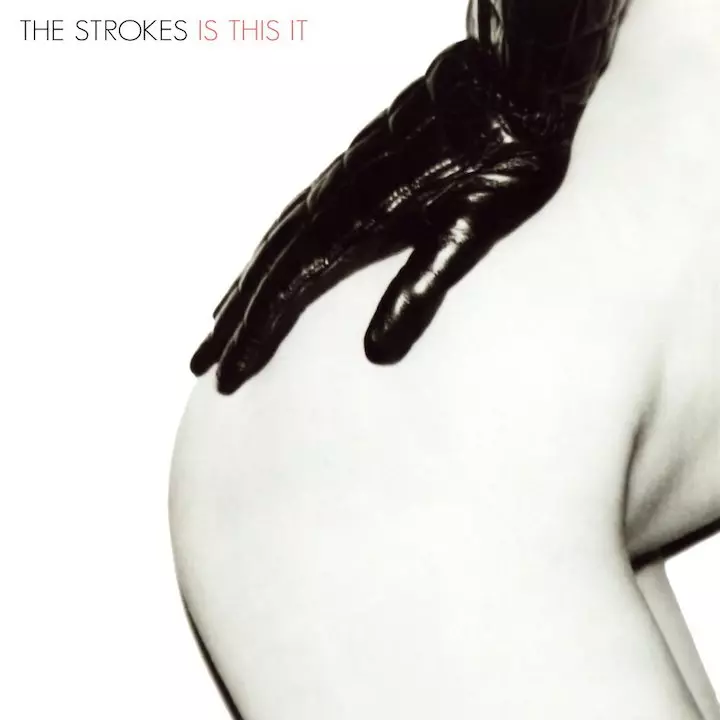
Hailed every bit the leaders of the "great-rock-revival", The Strokes' subscribed to the age-old model of "sex sells" for their S&K-inspired cover. A mix of Helmut Newton fashion photography and Spinal Tap'due south Smell The Glove, the evocative comprehend was shot past lensman Colin Lane, who used his girlfriend equally the model and a leftover prop to create the stark image. When it came to selling the album in us, however, stores weren't having it, and the encompass was changed to a close-up image of subatomic particle tracks in a bubble sleeping accommodation. Chalk this i upwardly every bit another win for puritanical America.
Amy Winehouse: Back To Blackness (2006)

As an creative person whose personal prototype is inseparable from her music, it was only fitting that the promising young vocalizer should grace her own album encompass. Back To Black would be her introduction to America and the rest of the globe, and much had changed since her UK debut, Frank. With her cascading hair, sleeve tattoos, and rockabilly makeup, even simply sitting in a chair appeared as an act of defiance, albeit with a hint of vulnerability, with her easily tucked between her legs. This indelible paradigm would come to ascertain Amy Winehouse'south legacy and inspired countless young girls to adopt her daughter-group-member-gone-bad mode.
Katy Perry: Teenage Dream (2010)
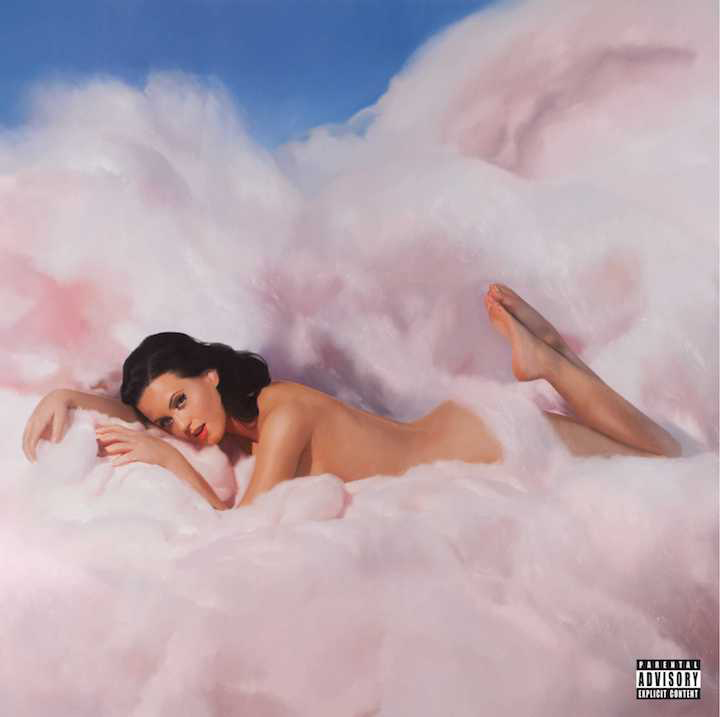
In popular music, there'southward no shortage of scantily-clad women on album covers, but it's usually the domain of male person musicians. Always one for pushing the envelope using her ain image, Katy Perry teamed up with Los Angeles-based artist Volition Cotton to create her ain pin-up artwork for the cover of her striking album, Teenage Dream . The outcome was the cartoonish sensuality of Fine art Frahm meets Candyland camp, and information technology has shaped Perry's Technicolor universe ever since. Cotton was besides the artistic director for Perry'south 'California Gurls' video, which established Perry's signature trademark of tongue-in-cheek sex appeal.
Notice the about controversial anthology covers of all time.
christensenmudis1966.blogspot.com
Source: https://www.udiscovermusic.com/stories/25-iconic-album-covers/
0 Response to "Italian Prog Album Art Cover Has People With Clocks for Faces"
Post a Comment